Tree Removal — Cost, Process and Scheduling in Enterprise, NV
Safe tree removal in Enterprise, NV. How we take down desert trees, what drives cost, warning signs a tree needs to come down, and how to decide.
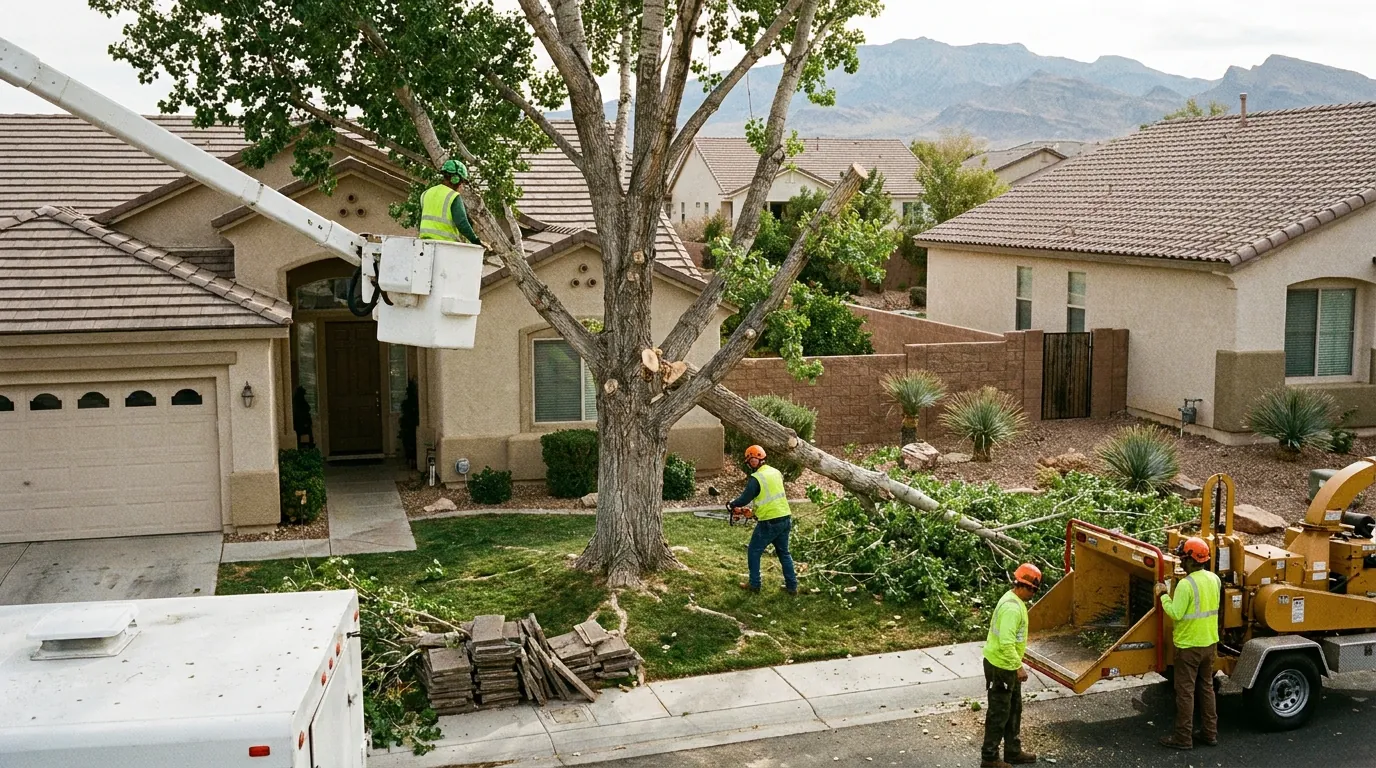
When a tree in Enterprise needs to come out
Not every struggling tree needs to come down, but some do — and in the arid heat and alkaline soils around Enterprise, trees fail in ways that aren't always obvious until a branch drops or a trunk leans overnight. Tree removal is the right call when a tree is dead, structurally unsound, lifting a foundation or driveway, crowding a structure, or has been damaged past the point where pruning can save it. We take the time to confirm that removal is actually the safer choice before anything comes down.
Searching for tree removal near me usually starts with a specific worry: a split trunk after a windstorm, roots heaving a walkway, or a tree that leafs out thin and pale every spring. These are the symptoms we look at first. If you're not sure whether the tree is beyond saving, a tree health assessment can settle the question before you commit to removing it.
Warning signs that a tree may need removal include large dead limbs high in the canopy, mushroom-like growth at the base, bark peeling away in sheets, a sudden lean with soil cracking on one side, and deep cracks running down the trunk. Desert trees like mesquite and acacia can look fine from a distance while hollowing out inside — which is exactly why a close look matters.
What tree removal involves, step by step
Every removal is planned around the tree, what's under it, and how much room there is to work. Here's the general sequence.
-
Assessment and plan
We look at the tree's lean, structural soundness, and what sits within falling distance — fences, roofs, power service, patios. In tight Enterprise lots there's rarely room to simply fell a tree, so we plan a rigging or sectional takedown instead.
-
Setting up the drop zone
We clear and protect the area below, set ropes where needed, and confirm where each piece will land. Desert yards often have decorative rock, drip lines, and AC units that all need protecting.
-
Sectional takedown
For trees near structures, limbs and trunk sections are lowered piece by piece with ropes rather than dropped whole. Open lots may allow a controlled fell, which is faster and lower-cost.
-
Clearing and cleanup
Branches are chipped, usable wood is cut down, and the debris is hauled off. We rake out the work area so you're not left stepping over wood chips in the gravel.
-
The stump decision
The stump is left flush or ground out, depending on what you want for the space. Grinding it is a separate step covered under [stump grinding](/services/stump-grinding/).
How Enterprise's climate and soil change the work
Enterprise sits in a hot, dry basin with alkaline desert soils and very little rainfall, and that shapes how trees grow and fail here. Many landscape trees are watered by drip line rather than deep natural moisture, so their roots stay shallow and spread sideways near the surface. A shallow-rooted tree is far more likely to tip in a gusty spring windstorm than one with a deep taproot — which is why a healthy-looking tree can go over suddenly.
Alkaline soil also stresses certain species, leaving them chronically weak and prone to dieback. Summer heat dries out dead wood fast, making brittle limbs more dangerous. And because our high-wind events tend to arrive quickly, a leaning or half-failed tree is better dealt with on a plan than left to come down on its own. When a tree has already come apart in a storm, that becomes an emergency tree service situation rather than a scheduled removal.
What drives the cost of a removal is size, location, and access — a tall tree wedged between a house and a block wall takes more rigging and time than one standing alone on an open lot. We walk the job with you so you understand what you're paying for before any work starts.
Thinking a tree may need to come down?
Call to set up a look at the tree. We'll tell you honestly whether removal is needed or whether trimming or monitoring is the better move.
Serving Enterprise and nearby communities across the southern valley.
Frequently asked questions
How do I know if my tree needs to be removed or just trimmed?
If the problem is overgrowth, crossing branches, or a few dead limbs, [tree trimming](/services/tree-trimming/) usually solves it. Removal is for trees that are dead, structurally failing, or too close to a structure to correct. A tree health assessment can tell the two apart.
Can you remove a tree in a tight space between houses?
Yes. Most Enterprise properties don't have room to fell a tree whole, so we use a sectional takedown — lowering limbs and trunk pieces with ropes. It takes longer but keeps the surrounding fences, walls, and roofs protected.
What happens to the stump after removal?
You choose. We can cut it flush to the ground, or grind it out so the area can be replanted or paved over. Grinding is handled as a separate stump grinding service.
What makes one removal cost more than another?
Size, height, species, and access are the main drivers. A large tree near power service or wedged against a building needs more rigging and labor than a small, free-standing tree on an open lot.
Do you haul away the debris?
Yes. Branches are chipped, larger wood is cut down, and everything is hauled off. We clean the work area before we leave so you're not left with debris in your gravel or beds.