Enterprise Tree Pros (702) 766-4332

When a tree becomes an emergency

A tree becomes an emergency the moment it stops being predictable. In and around Enterprise, that usually happens fast: a monsoon-season microburst rolls off the valley, gusts hit a canopy that spent the summer baking in arid heat, and a limb — or the whole trunk — gives way. If a tree or large branch is resting on your roof, blocking a driveway, tangled in a utility line, or leaning further than it was yesterday, that is not a job to watch and wait on. The load on the remaining wood is already past what the tree was built to carry, and a second gust or a shift in the soil can finish the failure with no warning.

This page is for homeowners in Enterprise and the surrounding Las Vegas Valley who are looking at a problem right now. We respond to storm damage, split trunks, hung-up limbs, trees uprooted out of loose alkaline soil, and branches hanging over walkways and vehicles. The goal of an emergency visit is simple: make the site safe, remove the immediate hazard, and give you a clear read on whether what's left standing needs a full tree removal or can be saved with corrective tree trimming.
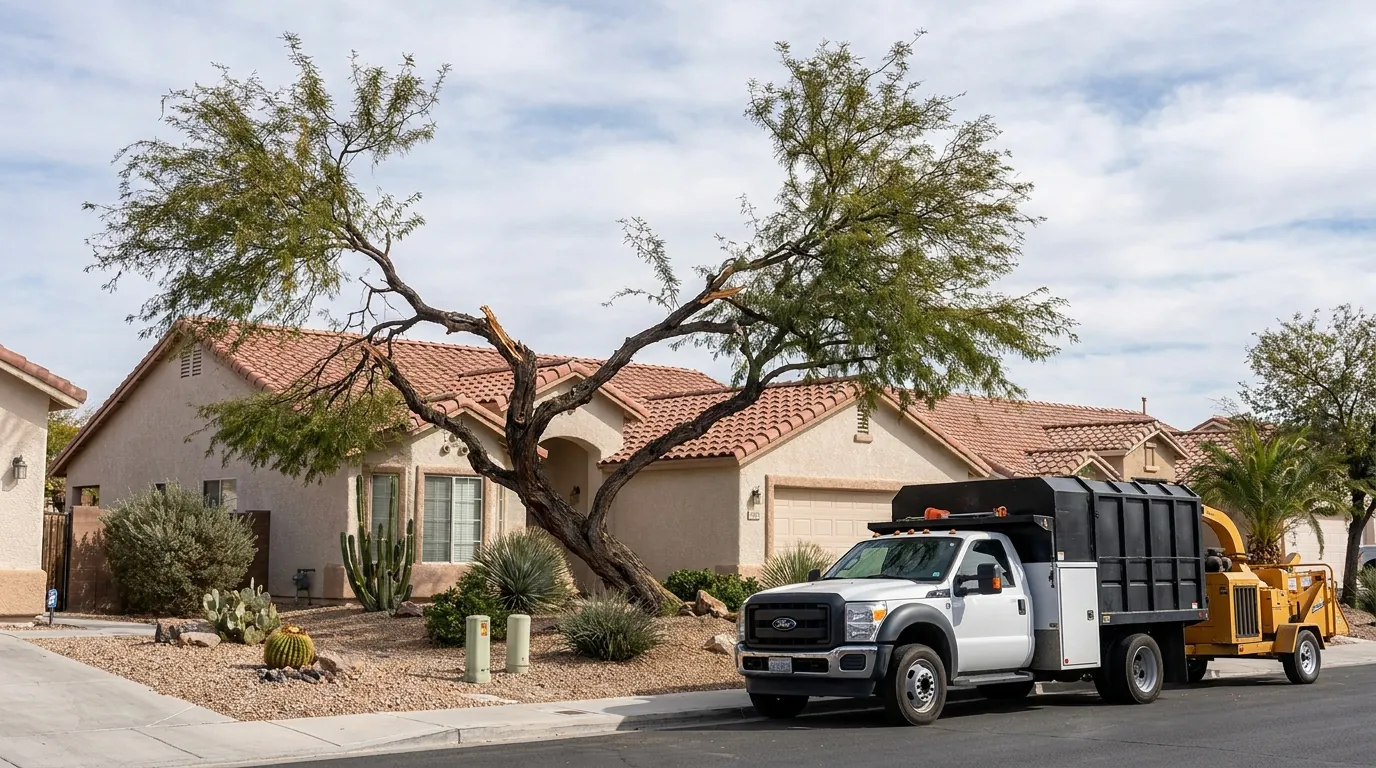
Warning signs you should call now

If you recognize any of these, treat the tree as unstable and keep people and vehicles clear of the fall zone.

A fresh lean after wind or rain

A tree that tilted during a storm — especially with soil heaved up or cracked on the opposite side of the lean — has already lost root anchorage. In our loose desert soils the root plate can lift surprisingly easily once it's saturated by rare heavy rain.

A split trunk or torn branch union

A trunk crack or a V-shaped branch union that has peeled open cannot heal under load. The exposed fibers are the only thing holding the weight, and they fail suddenly rather than slowly.

Limbs on a roof, line, or vehicle

Anything resting on a structure or power line is both a property risk and a shock risk. We stage the work to take the weight off in controlled sections rather than letting it drop.

A hung-up or hanging limb

A broken limb caught in the canopy — sometimes called a widowmaker — can release at any time. These are among the most dangerous things to deal with and should not be poked at from below.

What an emergency response looks like

Emergency work is about sequencing the hazard down safely, not rushing. Here is the typical order of operations.

  1. Assess and secure the area

    First we establish a drop zone and identify what's under tension and compression. A limb bent under load stores energy, and cutting it in the wrong place sends it moving. We rope off the area and keep it clear before any saw runs.

  2. Relieve the immediate load

    If a tree is on a roof or line, we take weight off in small, controlled pieces — often rigging and lowering sections with ropes rather than free-dropping them. Utility lines are left to the utility; we stay clear and coordinate.

  3. Remove or stabilize what's left

    Once the acute hazard is gone, we decide whether the remaining tree is sound enough to keep. A stable, healthy trunk may only need cleanup; a compromised one is scheduled for full removal.

  4. Clear and make passable

    We clear debris from access points — driveways, walkways, gates — so the property is usable, then lay out any follow-up work, such as [stump grinding](/services/stump-grinding/) or a wider cleanup.

How the local climate shapes storm damage here

Enterprise doesn't get the volume of rain that cracks trees apart in wetter climates — it gets the opposite problem. Trees here spend most of the year under arid heat and scarce rainfall, which means many root systems are shallow and reaching for irrigation water rather than anchored deep. When the summer monsoon brings a sudden downburst, the wind load arrives all at once onto trees that are already drought-stressed and brittle. Alkaline desert soils drain and shift differently than loam, so a soaked root zone can let a tree lean that looked perfectly solid a week earlier.

Species matters too. Fast-growing shade trees popular across the valley — certain pines, mulberries, and soft-wooded ornamentals — put on weight faster than they build strong wood, and they're the ones most likely to shed limbs in a gust. If a tree on your property has a history of dropping branches, that pattern tends to accelerate as it ages. A post-storm tree health assessment is often the smartest next step once the emergency itself is handled, so you're not back in the same spot after the next monsoon.

Have a tree down or leaning right now?

Call to describe what you're looking at. We'll help you judge how urgent it is and get a crew moving if it can't wait.

Keep people and vehicles well clear of any leaning tree or hanging limb until it's secured.

Frequently asked questions

What counts as a tree emergency versus something that can wait?

If a tree or limb is on a structure, blocking access, touching a line, or leaning more than it was, treat it as urgent. A dead branch high in a canopy with nothing underneath it is a real hazard but can usually be scheduled rather than handled at 2 a.m.

Do you handle trees tangled in power lines?

Anything in contact with a utility line is a shock risk and the utility's responsibility to de-energize first. We coordinate around that and work the parts of the tree that are clear once the line is confirmed safe.

Can a leaning tree be saved, or does it always come down?

It depends on how much root anchorage is left and whether the trunk is cracked. A young tree with minor lean and intact roots can sometimes be straightened and supported; a mature tree with heaved soil or a split trunk is almost always safer removed.

Will you clean up the debris the same visit?

The priority is removing the hazard, but we clear access points and haul what we can on the same visit. Larger cleanups, brush, and stump work are often scheduled as a short follow-up.