Canopy and foliage
Thin, off-color, or early-dropping leaves point to stress or root trouble. In the desert, dieback at the top of the canopy often shows up before anything else is obvious.
Tree health assessment in Enterprise, NV — reading stress, decay, and failure risk in desert trees so you can decide between saving and removing.
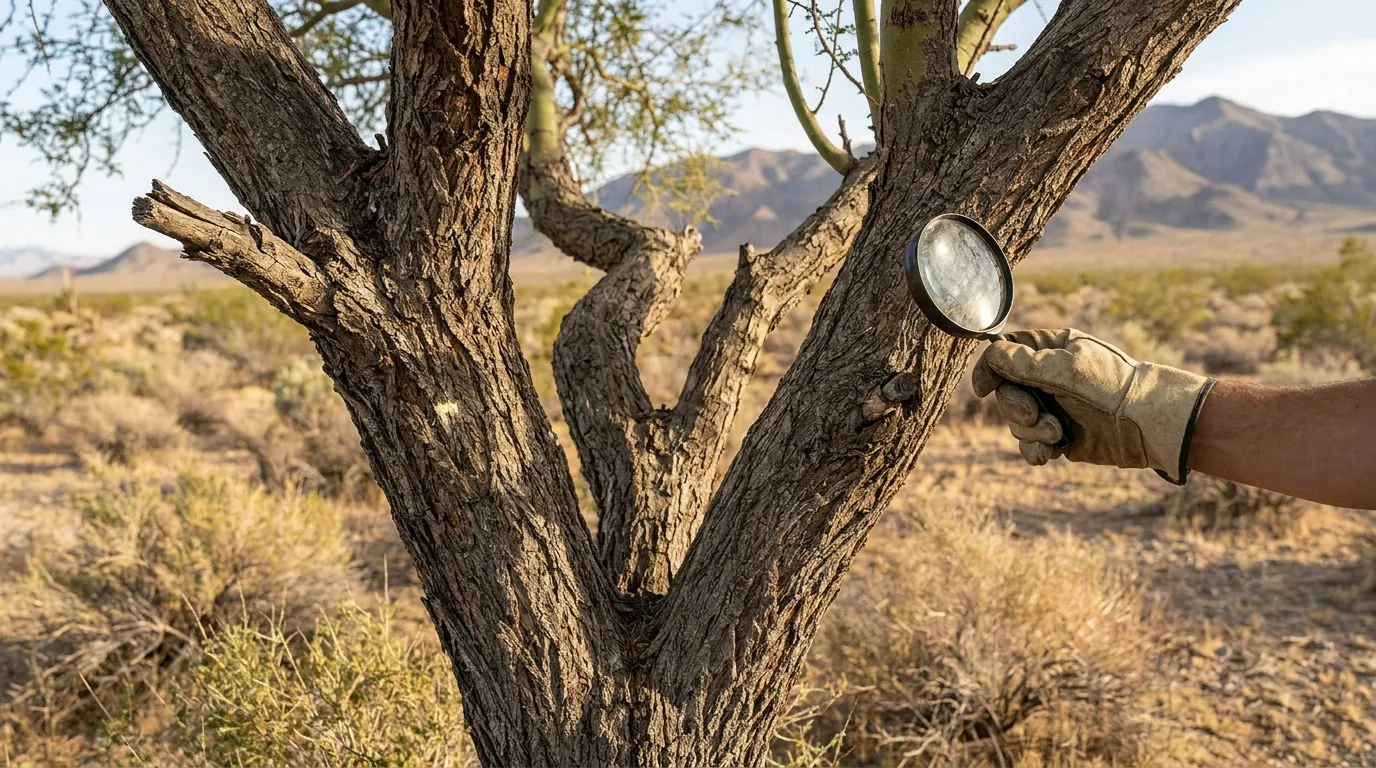
A tree health assessment exists to answer one practical question: is this tree worth keeping, and if so, what does it need? In Enterprise, where trees live under constant arid stress, that question comes up a lot — a tree can look fine from a distance and be quietly failing at the roots, or look ragged and actually be sound. Guessing wrong is expensive either way. Removing a tree that could have been saved loses years of shade; trimming or feeding a tree that's already past recovery just delays the inevitable while the hazard grows.
This is the step that should come before most decisions. If you're weighing a full tree removal against corrective tree trimming, an honest look at the tree's structure, foliage, bark, and root flare tells you which way to go. It's also the right first move after a storm, when damage isn't always visible, and when you're buying or developing a property and want to know what's really standing on it.
An assessment is a structured look at the whole tree, top to roots, not just the obvious problem.
Thin, off-color, or early-dropping leaves point to stress or root trouble. In the desert, dieback at the top of the canopy often shows up before anything else is obvious.
Cracks, cavities, oozing, loose or missing bark, and fungal growth are all clues to internal decay. A hollow or soft trunk changes the whole risk picture.
Weak V-shaped unions, crossing limbs, and oversized branches on soft wood are the parts most likely to fail in a monsoon gust — and often the parts a good trim can correct.
The spread where trunk meets soil tells you about anchorage. Heaved soil, exposed roots, or a trunk that enters the ground like a telephone pole are warning signs we take seriously.
The visit is methodical so the recommendation is based on evidence, not a glance.
We look at the tree from several angles and from the ground up, noting what's visible in the canopy, on the trunk, and around the base before touching anything.
We inspect unions, old wounds, cavities, and lean, and consider what's beneath or beside the tree — a target that would be hit if a limb or the trunk failed.
The same symptom means different things on different species and in different spots. A fast-growing shade tree near a roofline is judged differently than a tough native out in the open.
You get a plain read: keep and monitor, trim to correct structure, improve the care it's getting, or remove it. If removal is the call, we explain why rather than just quoting it.
Trees in Enterprise don't fail the way trees in wetter regions do, and that's exactly why a trained look matters. Local storm patterns, soil moisture, and native species determine how trees fail and when removal is the safer call. A tree can carry drought stress for years with a canopy that slowly thins, roots that stay shallow chasing irrigation, and wood that gets more brittle each season — none of it dramatic until a monsoon downburst snaps a limb or lays the whole tree over. Alkaline desert soils and scarce rainfall also change which pests and fungal problems take hold, so symptoms that would mean one thing in a lawn-and-loam climate can mean something else here.
An assessment turns that uncertainty into a decision. If the tree is sound, you save the removal cost and plan reasonable upkeep. If it's a hazard, you learn it before the storm does, and you can schedule the work on your terms rather than during an emergency tree service call at the worst possible time. For anyone clearing a parcel, it's also the way to decide which trees are worth protecting before the lot and brush clearing crew arrives.
Call to set up an assessment. We'll look at the tree honestly and lay out your real options.
If a tree is actively leaning or dropping limbs, treat it as urgent rather than waiting for a scheduled assessment.
Good triggers are visible decline — thinning canopy, dead branches, cracks, or fungal growth — after a storm, or before buying or developing a property. It's also worth it any time you're about to spend money on a tree and want to know it's not wasted.
Often, yes. Many trees that look alarming are structurally fine and only need corrective trimming or better watering. The point of the assessment is to avoid removing a healthy tree or pouring care into one that's already failing.
We explain what's wrong and why it matters, then lay out options — removal, structural trimming, or monitoring with a timeline. You decide, with a clear picture rather than a guess.
They can. Drought-stressed trees often decline slowly and shallow-rooted ones can lose anchorage without obvious signs until wind or rain exposes it. Looking before a storm is far cheaper than dealing with the failure afterward.