Tree Removal Service in Enterprise, NV
Tree removal service for Enterprise, NV homes. Safe takedown of dead, storm-damaged, or hazardous desert trees on tight residential lots.
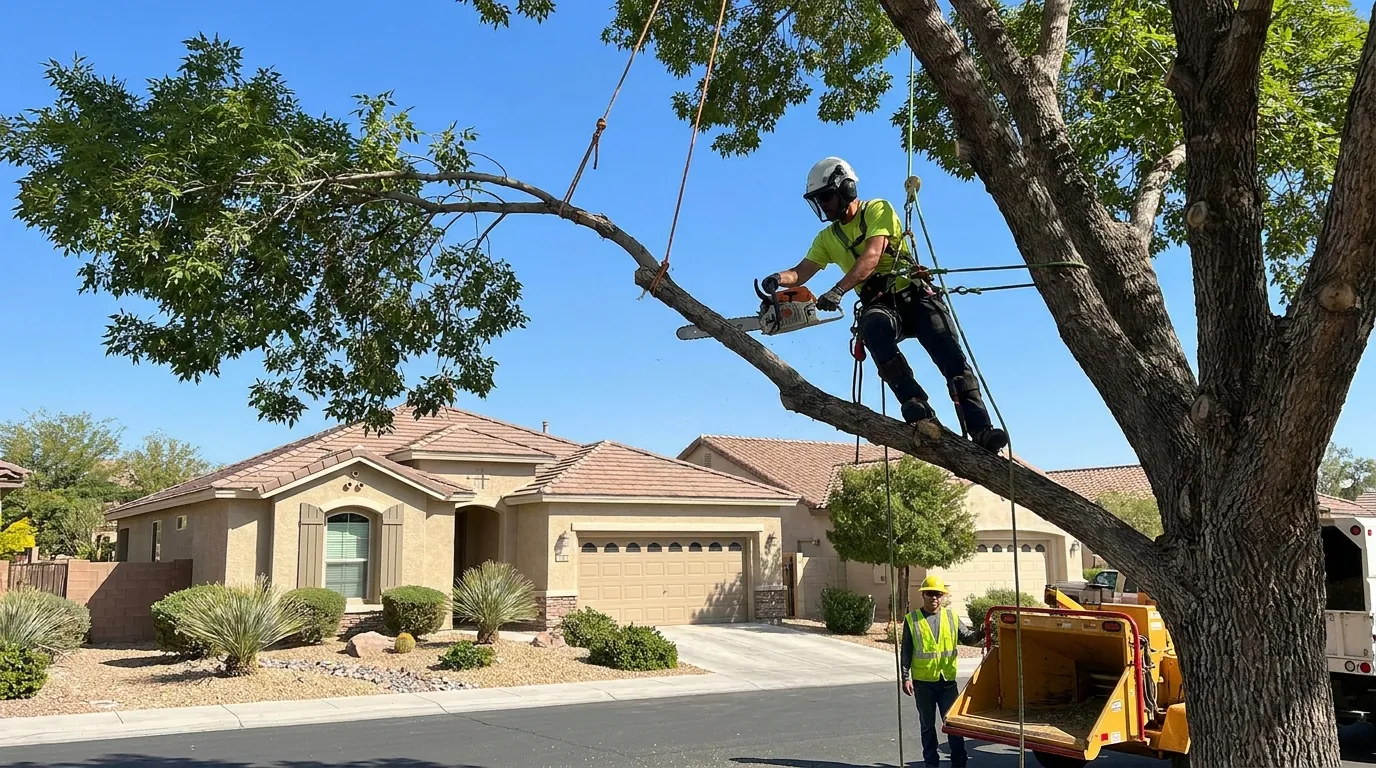
When a tree in Enterprise needs to come down
A tree that has died, split, or begun leaning toward a house rarely fixes itself. In Enterprise, NV, the pressure comes from a specific set of conditions: relentless arid heat, alkaline desert soils that hold little water, and long stretches with almost no rainfall. Non-native ornamentals and older desert species alike get stressed here, and a stressed tree is a heavier, more brittle tree. When you search for a tree service near me, what you usually need is an honest read on whether a tree can be saved or has to be removed.
Warning signs that a tree has moved past pruning and into removal territory include large dead limbs at the crown, bark that peels away in sheets to expose dry wood, mushrooms or soft rot at the base, and a trunk that has started to lean after wind or after soil around the root plate has shifted. Trees planted too close to foundations, block walls, pools, and pavers are also common removal candidates in Enterprise's dense residential neighborhoods, where root systems have nowhere to spread but under hardscape.
This page covers full tree removal service. If your tree is damaged but potentially recoverable, start with tree removal repair instead, and if you are planning what to plant afterward, see tree removal installation.
How a removal actually happens
Removal on a desert residential lot is a controlled, sectioned process, not a single cut. Here is the sequence we follow.
-
Assessment and access plan
We walk the site, judge the lean, decayed wood, and the health of the root plate, then map where the tree can safely fall or be lowered. On tight Enterprise lots the answer is almost never a straight felling — it is a piece-by-piece takedown to protect walls, pools, and neighbors.
-
Clearing the drop zone
Furniture, vehicles, and anything breakable is moved clear. In yards backing to block walls we set up so limbs come down inside the property line, not over it.
-
Sectional removal
Limbs are cut and lowered in manageable pieces, working from the top down. Rope and rigging control each section so nothing free-falls onto hardscape — important where dry desert wood shatters on impact.
-
Trunk felling or dismantling
Once the crown is gone, the trunk is either felled into a cleared space or dismantled in sections where there is no room to drop it.
-
Stump decision and cleanup
We discuss whether to grind the stump or leave it, haul the debris, and rake the area clean so the space is ready for whatever comes next.
Get an honest read on your tree
Send a couple of photos and a description of what you are seeing, and we will tell you whether the tree needs to come out or can be worked with.
Serving Enterprise and nearby valley communities.
Frequently asked questions
How do I know if my tree needs removal instead of trimming?
Removal is usually warranted when more than half the crown is dead, when there is significant trunk decay or a soft, hollow base, or when the tree leans after root movement. If the damage is limited to a few broken limbs, trimming or repair work often keeps the tree. We give you a straight assessment either way.
Can you remove a tree that is right against my block wall or pool?
Yes. Tight clearances are the norm on Enterprise lots, so we plan sectional takedowns and use rigging to lower pieces rather than dropping them. This keeps weight off walls, coping, and pavers throughout the job.
Do you remove the stump too?
Stump removal is a separate decision. Some homeowners grind it out to reuse the space or plant again, while others leave a low-cut stump. We will explain the tradeoffs based on where the stump sits and what you want to do with the spot.
Is winter or summer better for tree removal here?
Removal can be done year-round in the Enterprise climate, but the cooler months are easier on crews and on any surrounding plants. Dead or hazardous trees, however, should not wait for a season — those come out when they are found.